Showing posts with label M.A. and W.A.J. Claus. Show all posts

Monday, October 28, 2013

Anne of Green Gables, Chapters Thirty-Seven and Thirty-Eight

In which there is sadness, new plans, reconciliations, and the bend in the road.


Our final installment of Anne of Green Gables brings with it our final original illustration, as well:

25:26 - "'Come, I'm going to walk home with you.'"

Obviously destined to be together.

Anyways, Ms. Montgomery inserts a couple of other quotes. She makes reference to "loss in all familiar things," a reference to the poem "Snow-Bound: A Winter Idyl" by John Greenleaf Whittier, a long poem in which a family is trapped in the homestead for three days during a snowstorm, and pass the time by sharing stories. The quote comes, unsurprisingly, from a section about mourning a lost loved one.

The "Josiah Allen's wife" Anne refers to is Marietta Holley, a satirist from the last 1800s who appears to be largely forgotten today. The term "mejum" appears to come from Holley's novel called — oh dear — Sarah Among the Colored Folks. It seems to mean "medium," in context meaning "moderate" or "reasonable."

When the narration refers to Avonlea as "a haunt of ancient peace," it's quoting Tennyson again, this time his poem "The Palace of Art," supposedly referring to Gunby Hall, a country house in England allegedly haunted by the spirit of a former servant who was murdered sometime in the early 1700s by the hall's lord as he was running away with the lord's daughter (or maybe wife.) Nice and peaceful!

Finally, Anne's last line is from "Pippa Passes," a drama by Robert Browning. The whole quote goes:
"The year’s at the spring,
And day’s at the morn;
Morning’s at seven;
The hill-side’s dew-pearled;
The lark’s on the wing;
The snail’s on the thorn;
God’s in His heaven—
All’s right with the world!"
Which of course brings us to the end of the book. Thanks so much for listening.

(And like you didn't get at least a little choked up too. Shut up.)


If you would like to read along, the text can be found at Project Gutenberg. No reading ahead, though!

Wednesday, October 23, 2013

Anne of Green Gables, Chapters Thirty-One to Thirty-Three

In which Anne freaks out over the Entrance exam to Queen's Academy, does well enough on it, I suppose, then freaks out over a recitation at a concert, and does well enough at it, as well, I suppose.


In this extra-long installment (...sorry), we again get to see Ms. Montgomery's fondness for quoting within the narration, from sources not especially well-known today. The first time is while discussing the joys of learning, when she says "Hills peeped o'er hill and Alps on Alps arose." This is actually a past-tense paraphrase of a line from "An Essay on Criticism" by Alexander Pope, perhaps best-known for being the source of the phrase "A little knowledge is a dangerous thing." This, though, actually means rather the opposite of what many people think. The full couplet, which is from the same section of the essay as the line above, reads: "A little learning is a dang'rous thing; / Drink deep, or taste not the Pierian spring," where the Pierian Spring is the source of knowledge in Greek mythology. Pope then goes on to discuss how only learning a little "intoxicates" you, while learning a lot "sobers us again." So, it's not that knowledge is dangerous, it's a little knowledge that's dangerous. Learning more shows you how little you actually know, and just how much more there is to learn; as we look out over the mountains of knowledge, "Hills peep o'er hills, and Alps on Alps arise!"

 The next quote comes as Marilla is thinking -- to herself, of course -- about how nice Anne looks all gussied up, with that "One moonbeam from the forehead to the crown." This is from the Fourth Book of the poetic novel Aurora Leigh by Elizabeth Barrett Browning. It comes from what appears to be an insincere compliment imagined by the eponymous narrator: "No one parts / Her hair with such a silver line as you, / One moonbeam from the forehead to the crown!" So basically, a poetic way of referring to a part in someone's hair.

At the concert, Anne recites "The Maiden's Vow" by Carolina Oliphant, a surprisingly short and determinedly Scottish poem where a woman swears she'll never marry, as her only love died at sea. Very tragical.

Lastly, Diana tells Anne that a romantic-looking American artist behind her referred to Anne as having "Titian hair." Anne herself explains what that means, at least well enough for our purposes. My wife, who has studied more art history than I have, tells me that there's an easy mnemonic to help remember what kinds of things Titian painted, but she won't tell me what it is.

Oh and hey! We finally get to see the frontispiece illustration!

Diana fixes Anne's hair.
28:45 - "'There's something so stylish about you, Anne,' said Diana."

Not the most action-packed picture in the book, but lovely in its own right.

And by the way, I had an audience for the last little bit of the recording. See if you can spot evidence of her!


If you would like to read along, the text can be found at Project Gutenberg. No reading ahead, though!
Friday, October 18, 2013

Anne of Green Gables, Chapters Twenty-Seven and Twenty-Eight

In which Anne is engaged in a sitcom plot, re: hair-dying, and becomes rather un-romantically stranded whilst pretending to be romantically dead, only to be rescued by a most unwelcome savior, coming as a surprise to precisely no one.


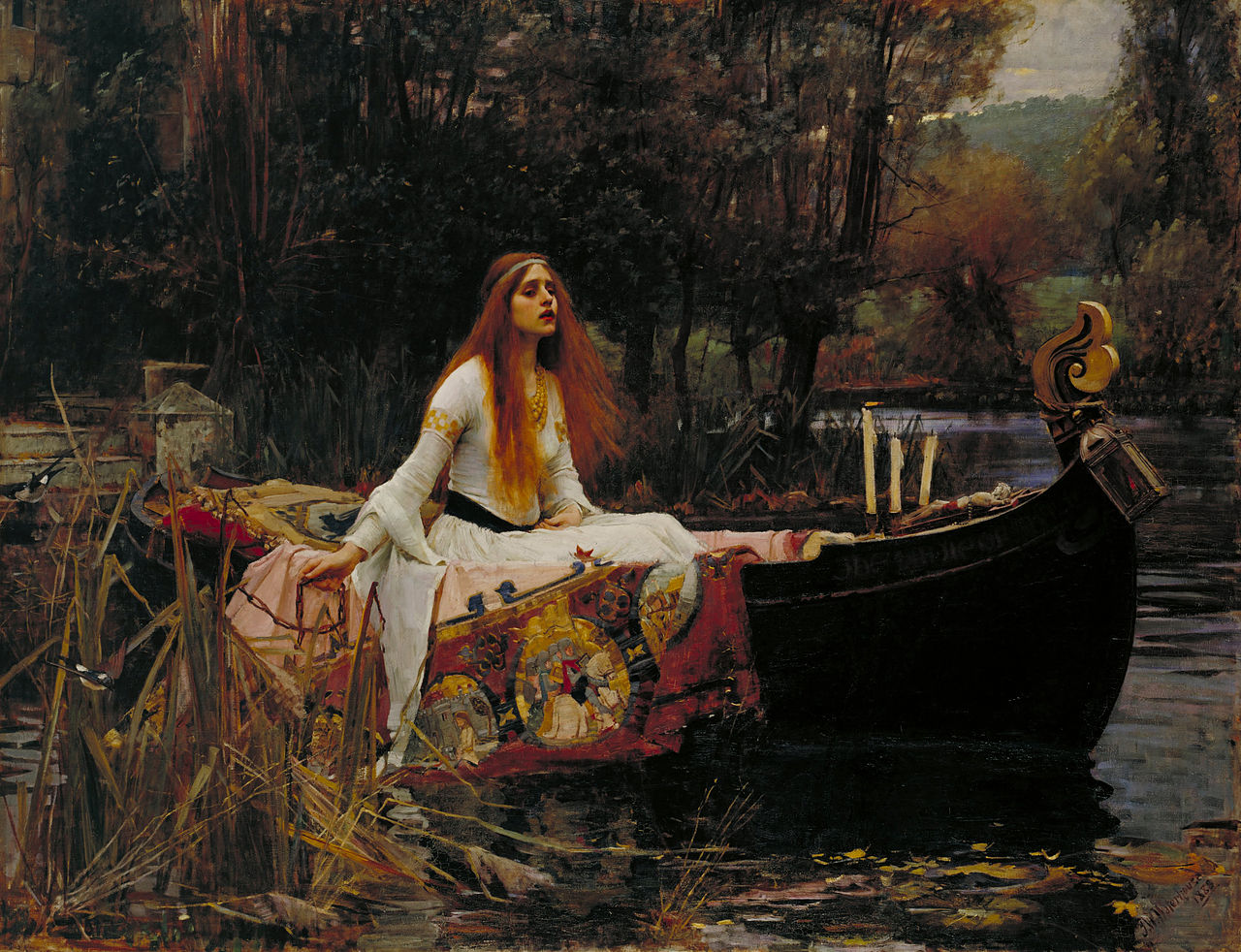
The poem that Anne and her friends are reenacting in Chapter 28 is "Lancelot and Elaine," from Idylls of the King by Alfred, Lord Tennyson. The short version is that Elaine of Astolat fell in love with Lancelot and died of a broken heart after he rejected her (because he was totally sweet on Arthur's queen, Guinevere. Um, spoilers?) Per her orders, her body is placed in a boat, holding a lily in one hand and a letter in the other, then floated down the Thames towards Camelot. Her body's discovered by King Arthur's folks, whereupon Lancelot reads the letter and feels all angsty. You may know her better as the Lady of Shalott, by which name Tennyson wrote not one, but TWO poems telling her story. Tennyson... really liked this one, I guess.

Oh, you'll also know her from that poster that friend of yours had in college:

Yup. You know the one. Maybe YOU were the friend that had it.

Less romanticized, we see Anne here clinging to the bridge pile being rescued by Gilbert:


21:38 - "He pulled her close to the pile and extended his hand."

Oh, and in case you were curious, that boat there in the picture is what they've been calling a dory. It's basically exactly what you see in your head when you think "rowboat." And... look. I haven't actually read the rest of the Avonlea series yet, but I know it follows Anne well into adulthood and picks up at one point with her own children (I have the rest of the series, and have read their backs, okay?) You can't possibly tell me that Gilbert's not gonna be her husband eventually after all this. Seriously.

Also, this time I get to apologize to Italians, and probably also to German Jews. It... it was a different time.


If you would like to read along, the text can be found at Project Gutenberg. No reading ahead, though!

Monday, October 14, 2013

Anne of Green Gables, Chapters Twenty-Two to Twenty-Four

In which Anne goes to tea with her latest kindred spirit, endangers her life and inflicts physical trauma on herself for inconsequential reasons, and then gets excited over a concert; and in which our narrator is glad that so few of the girls present at the party had speaking lines, for he can only come up with so many distinct little girl voices at one time.


Oh hey, we've come back around to one of the illustrations!

11:28 - "Balanced herself uprightly on that precarious footing."

Here, of course, we see Anne trying to walk across the ridgepole of the Barrys' roof on a dare from that hussy Josie Pyle. Note, of course, that they don't have an illustration showing her broken body amidst the wreckage of the Virginia creeper.

In these chapters, we hear Anne described as being "all spirit and fire and dew," which comes from the poem "Evelyn Hope" by Robert Browning. The whole line is "The good stars met in your horoscope, / Made you of spirit and fire and dew," and is actually on the title page of the book, which I did not notice when I started reading.* I can see how it can apply to Anne here, but you read the whole poem and it appears to be about the 48-year-old Browning hitting on the 16-year-old Evelyn Hope who just died, and it gets just a bit weird. We also hear of Anne reciting "Mary, Queen of Scots" by Henry Glassford Bell, which is much less creepy, being only about a beheading. It... really didn't occur to me that I'd be able to use the "dismemberment" tag in Anne of Green Gables, but I certainly won't turn down the opportunity.


If you would like to read along, the text can be found at Project Gutenberg. No reading ahead, though!

*I also negelected to read the dedication, which is "To the memory of my Father and Mother."

Friday, October 4, 2013

Anne of Green Gables, Chapter Fifteen

In which Anne begins to attend school, where the last of the major players is introduced with the most dreadful insult, and Anne decides that Canadian public education has failed her.


We've got an especially good illustration this time around, of Anne about to full on break a hunk of slate over Gilbert's head because he called her "Carrots." YES.

The students look on in amazment as Anne holds her slate aloft, preparing to bring it down on the flinching Gilbert Blythe
12:32 - "Thwack! Anne had brought her slate down on Gilbert's head." Could the
word "Gilbert" really not fit on the next line, it had to be split in the middle like that?

I mean, yes, I know that classroom slates are real thin and it's not like she dropped a paving stone on his skull or anything but still. Sweet. You can tell these two are meant to be together. What, that's no spoiler or nothing. Just look at that picture up there. If that's not true love, I don't know what is.

Oh, and hey, I just realized a missed an illustration back in chapters 9-11, so you might want to go on back and take a look-see.


If you would like to read along, the text can be found at Project Gutenberg. No reading ahead, though! 

Monday, September 30, 2013

Anne of Green Gables, Chapters Nine to Eleven

In which Mrs. Rachel Lynde and Anne are terribly rude to each other, Anne enjoys apologizing perhaps a bit too much, and we all learn of the importance of puffed sleeves, and not for the last time let me tell you.


Oh, we've got a delightful illustration for this set of chapters, of Anne flying into a temper at Mrs. Lynde's... critique of Anne's appearance. This is not the last time we will see Anne's temper illustrated.

Anne stamping her foot while yelling at Mrs. Lynde in front of Marilla
5:08 - "'I hate you,' she cried in a choked voice, stamping her foot on the floor."

Quick couple of notes: Mrs. Lynde had suffered from the grippe, which I've seen and heard a ton in old media but had to look up to figure out precisely what it is. Turns out it's just another word for the flu. At the end of Chapter 9, when Marilla leaves "this Parthian shaft to rankle in Anne's stormy bosom" (and BOY does that sentence come across differently out of context) she's referring to a tactic of the Parthians, an Iranian people known for their archery, to feign retreat and then fire while running away. Thus, a metaphorical "Parthian shaft" is getting that one last verbal jab in before leaving. I noticed, though, that upon googling the phrase, an awful lot of the results refer directly to its usage here in Anne of Green Gables, so I wonder just how widespread an idiom it was.

UPDATED 10/3/13: Well, drat, somehow I completely missed that there was a whole 'nother illustration in this section! Here, we get to see Anne walking down the church aisle, with the wreath of flowers on her hat:

Anne, with flowers on her hat, walks down the aisle while the other parishoners stare and whisper behind their hands
29:55 - "They looked at her and whispered to each other."

Note that the other ladies do indeed have puffed sleeves. This will come up a surprising amount.


If you would like to read along, the text can be found at Project Gutenberg. No reading ahead, though! 

Wednesday, September 25, 2013

Anne of Green Gables, Chapters Three to Five

In which it is Marilla's turn to be surprised, Anne discovers that she is not a boy, Matthew states an opinion, and Marilla learns of Anne's past.


And now we get to the first of the illustrations in the book, portraying Anne's first meeting with Marilla, and capturing one of the many, many moments this book will contain where I will attempt to not giggle when reading the word "ejaculated."

Matthew and Anne stand in the kitchen before a rather judgemental Marilla
0:52 - "Matthew Cuthbert, who's that?" Marilla does not beat around the bush.

If you would like to read along, the text can be found at Project Gutenberg. No reading ahead, though!