Showing posts with label Avonlea. Show all posts

Thursday, June 4, 2020

Anne of Avonlea, Chapters Twenty-Nine and Thirty

In which the storybook romance has a happy ending, and Anne prepares for the next phase of her life; and in which your narrator can finally update his "currently reading" status on Goodreads.


Our final cover for this book is from a 2014 edition published by Sourcebooks Fire, the YA imprint of Sourcebooks. It's designed by Canadian illustrator Jacqui Oakley, who posted the in-progress rough designs of this cover on her site (scroll down a bit.) Oakley illustrated covers for the whole series, of course, and says that "as you can imagine, I got pretty good at painting red hair throughout this project. Each cover depicts Anne as she grows up, a specific building related to each story, as well as flowers and animals native to PEI." It's a lovely set of covers all together, and I appreciate the thoughtfulness that obviously went into each, and the fact that while none depict a specific scene from the book, they don't fall into the completely generic trap that so many of the others I've looked at do. A beautiful cover to bring our reading to a close.

But we're not going to get out of this without a whole bunch of notes! Even though this isn't as long as the last two installments we somehow managed to need even more annotation, so look for them behind the jump.

Monday, June 1, 2020

Anne of Avonlea, Chapters Twenty-Seven and Twenty-Eight

In which Miss Lavendar is sad and becomes increasingly attached to Paul, and the romantic ending to her story begins to come into focus, much to Anne's delight.


AAAH, look how cute this one is! Published by Sweet Cherry Publishing in 2018, with cover and illustrations by Elena Distefano. This is another oddly rare one to show an actual scene from the book, in this case Anne's embarrassing introduction to a famous author, when she was in kerchief and an old dress for cleaning and had just been changing the feathers in a mattress, oh and had accidentally turned her nose red. Ms. Distefano apparently decided to leave out the dyed nose, which admittedly would have looked rather odd and off-putting on a completely out-of-context cover. As it is, Anne just looks adorably flustered, and I love her.

Another extra-long one, so once again lots of notes coming your way!

5:50 - "fish days." Davy's talking about days where you "fast" by eating fish instead of meat, as Catholics used to do every Friday, and as several religions still do every Friday of Lent. It's established in the first book that the Cuthberts are Presbyterian and as near as I can tell they never had the "every Friday" rule, so he's likely just talking about various days of religious observation.

7:24 - "grow like pigweed in the night." "Pigweed" can apparently refer to any of a number of different weedy plants that have been used as pig feed, but I'm pretty sure this is probably referring to Amaranthus retroflexus

9:25 - "flourish like green bay trees." This is a reference to Psalm 37:35, which reads in the King James Bible as "I have seen the wicked in great power, and spreading himself like a green bay tree." It's apparently more correctly translated as something like "a tree in its native soil." It didn't originally refer to any specific type of tree, but translations usually go with the bay laurel, an evergreen tree (thus, flourishing all year round) whose leaves were used to make the ancient Greek and Roman laurel wreaths and crowns and which, I am only just now learning, is the plant that the bay leaf comes from. Huh.

13:28 - "blue pills." This is vague enough that it could mean just about anything, but there's a good chance Miss Lavendar is referring to the medicine known as "blue mass," a — yikes — mercury-based medicine of the time that was prescribed for everything from syphilis to constipation to toothache to childbirth pains to tuberculosis. Miss Lavendar is probably talking about how it was also prescribed for melancholia (now known as "depression.") In fact, Abe Lincoln supposedly took it for just that reason, though of course he eventually died due to a different sort of heavy-metal poisoning altogether.

. . .too soon?

14:28 - "pelican of the wilderness." This is another Psalms reference, this one to Psalm 102:6, part of a prayer outlining how miserable and wretched the supplicant is: "I am like a pelican of the wilderness: I am like an owl of the desert" (KJV, again.) Once again it's unclear what specific birds are being referred to here, with other translations going with some variety of owl. Regardless, it's some sort of solitary bird in the desert, or wilderness, or ruins, or wasteland. Basically the antithesis of Anne Shirley in a strawberry patch.

19:18 - "vine and fig tree." Another Biblical reference, though not Psalms this time. A version of the phrase is actually used three times: Micah 4:4, 1 Kings 4:25, and Zechariah 3:10, all of them basically referring to the simple joy of living on your own land.

26:20 - "subscribed to the salary." The salary of a local minister in towns like Avonlea were paid by the congregation themselves, who would all pledge to pay a certain amount to make the total promised. Mr Harrison has apparently agreed to pay a share as well.

28:52 - "capital of Afghanistan." Ooh, I know this one! It's Kabul!

28:54 - "dates of the Wars of the Roses." Ooh, I definitely do not know this one! They're apparently May 22, 1455 - June 16, 1487. The Wars of the Roses, incidentally, were a war between rival factions of the House of Plantagenet, the Yorks and the Lancasters, who both claimed the throne of England. They basically wiped each other out, ending with the Lancastrian Henry Tudor killing off Yorkie Richard III in the Battle of Bosworth, then taking the crown as Henry VII and marrying Elizabeth of York, uniting the houses (more or less) and creating the new House of Tudor. I'm sure there are some nuances I'm missing, but I got the dates and so am one up on Anne's students.

29:20 - "organdy." Organdy is a thin, semi-sheer, plain weave cotton fabric. It's best known as a stiff fabric used for curtains and petticoats, but there was also a soft version of it used for dresses.

29:49 - "Foreign Missions." Presumably, Miss Lavendar means she donated to the missionaries in the church who would go to foreign countries.

31:39 - "burst flower-like into rosy bloom." This is from the 1866 poem Snow-Bound: A Winter Idyl, by John Greenleaf Whittier. Whittier was a Quaker, and best known for his work and writings as an abolitionist. Abolition thankfully and by necessity went out of favor after the Civil War, at which point he wrote Snow-Bound, his most successful work. It's a long narrative poem, framed as a series of stories told by a family while snowed in. The quote in question is describing how the "old, rude-fashioned room" they are in lights up when the hearth-fire is lit.

38:00 - "Prince Charming." Okay, obviously you all know what this means, the stock fairy-tale prince who exists solely to rescue the heroine and provide her with a happily-ever-after marriage. Most famously, the princes in Sleeping Beauty, Snow White, and Cinderella fit the bill. But it did get me to wondering where the specific term came from. Not Disney, of course, since Anne of Avonlea predates any of his works by decades. Arguably, it indirectly grew from two tales by Madame d'Aulnoy written in the 1600s: The Story of Pretty Goldilocks (no, not that Goldilocks) in which the hero's name was Avenant ("Fine" or "Beautiful" in French), and The Blue Bird, in which the hero was Le roi Charmant ("The Charming King.") When Andrew Lang published these stories in the 1890s in his Blue and Green Fairy Books, respectively, he translated the names to "Charming" and "King Charming."

Close, but those guys aren't princes! It seems that the first known use of the exact term "Prince Charming" is in, of all places, the 1890 novel The Picture of Dorian Gray by Oscar Wilde. It's what the doomed actress Sibyl calls Dorian as he courts her. It's interesting that this first use of the term is already deconstructed and ironic, as (spoilers) Dorian is not exactly the hero of the tale, and certainly does not deliver a happily-ever-after to Sibyl.

41:23 - "nods and becks and wreathed smiles." This comes from the poem "L'Allegro" by John "Paradise Lost" Milton, published in 1645. "L'Allegro" means "The Happy Man," and it's a pastoral poem framed as a supplication to the Greek goddess Euphrosyne, the Grace of Mirth. The line is from a portion where he's asking her to appear:
Haste thee nymph, and bring with thee
Jest and youthful Jollity,
Quips and Cranks, and wanton Wiles,
Nods, and Becks, and Wreathed Smiles...
The companion piece to this poem is "Il Penseroso," or "The Melancholy Man," a structurally identical poem where the writer dismisses all joy from his mind and hails an unnamed goddess of Melancholy. So. . . not so much Anne Shirley, except maybe in her more dramatic moments.


If you would like to read along, the text can be found at Project Gutenberg. No reading ahead, though!

Sunday, May 17, 2020

Anne of Avonlea, Chapters Twenty-Five and Twenty-Six

In which Mr. Harrison's marital scandal rocks Avonlea, and Thomas Lynde's death really kind of works out well for everyone.


Oh my, this is quite possibly my favorite cover I've found so far. It's from a 2014 printing of the whole series by Tundra books, and is a paper-cut illustration by Elly MacKay, with cover design by Kelly Hill. You can see MacKay's covers for the rest of the series (along with an unused illustration and covers for several other Montgomery books) here. Beyond the fact that the illustrations themselves are lovely (look at the details! Anne's dirty hem from where she's stomping in the mud!), the fact that it's actually a photograph of physical paper cutouts adds a gorgeous depth of field and luminance to the image. Beautiful.

This was an extra-long installment — these end chapters are getting long, so it's either an extra-short installment with one chapter or an extra-long one with two — and thus has a goodly number of notes. Try to keep up!

4:16 - "as neat as if she had just stepped out of the proverbial bandbox." A bandbox is another term for a hatbox, and this was indeed an idiom of the time for when someone looked especially fresh and neat.

4:56 - "Fair Unknown." Mrs. Harrison here is being compared to a figure from Arthurian legend, and unknown young man of questionable lineage who just shows up in court one day demanding to be knighted. He's usually knighted quickly, but then has to prove his worth, and it's also usually discovered that he's actually a relative of Gawain's and thus of Arthur himself.

6:34 - "such stuff as dreams are made of." While at this point this quote might be better known from its famous use in the 1941 movie of The Maltese Falcon, Sam Spade is quoting Prospero from Shakespeare's The Tempest (Act 4, scene 1). Prospero's speech follows him ending a play-within-a-play, but it's okay because none of it was real anyway, the actors "were all spirits, and are melted into air, into thin air" — oh yes, this is where "into thin air" comes from — but the real world is "like the baseless fabric of this vision," everything ends, life is insubstantial. "We are such stuff as dreams are made on; and our little life is rounded with sleep." I won't blame Anne too badly for getting the last word wrong ("of" instead of "on"); it feels more natural so it's a common change, and she had just had quite a shock after all. 

7:58 - "Mrs. Lynde rushed in where Anne had feared to tread." This is of course a reference to the well-known idiom "fools rush in where angels fear to tread," but I was unaware that this is yet another from our friend Alexander Pope, this time from his Essay on Criticism, which also supplied us with "to err is human, to forgive divine" and, if you cast your memory back to our reading of Anne of Green Gables chapter 31, "a little learning is a dangerous thing."

14:23 - "pattern housekeeper." This was kind of a hard one to track down, as the phrase is just specific enough to make it seem like it's an actual reference, but vague enough that searches pull up all sort of other unrelated stuff. It seems to be using the word "pattern" in the sense of a model, or something to be imitated, as context clearly shows that it means a very scrupulous housekeeper. I did find a semi-satirical article on the concept by Mrs. N. T. Munroe in "The Ladies Repository," volume 19, from 1851. It definitely makes it clear that "pattern housekeeping" was A Thing that existed, but still have no idea where the term came from, if indeed anyone knows.

23:46 - Roses red and vi'lets blue, / Sugar's sweet, and so are you." Okay, Davy, you're following up Alexander Pope and Shakespeare, you need to step up your game. This was trite even for a seven-year-old in the 1870s(?) I know everyone here knows it, but you may not know that it goes back at least to a 1784 collection of nursery rhymes, and arguably as far back as Edmund Spencer's The Faerie Queene from 1590 with the lines:

She bath'd with roses red, and violets blew,
And all the sweetest flowres, that in the forrest grew. 

35:26 - "airy silver." This description of moonlight comes from Anne's old friend, Alfred, Lord Tennyson, who we just ran into a few chapters ago. It's from his poem "Audley Court," published in the same 1842 collection of poetry that contained "The Lady of Shalott," which you surely remember from when it stranded Anne in the middle of a river. Anyway, the pertinent bit goes like this:

...but ere the night we rose
and saunter'd home beneath a moon, that, just
In crescent, dimly rain'd about the leaf
Twilights of airy silver, till we reach'd
The limits of the hills...

38:37 - "sitting Turk-fashion." According to the Wikipedia article on "Sitting," which is a real thing that exists, this is just an slightly old-fashioned and primarily European term for "sitting cross-legged on the floor;" what Americans of my generation and older usually called "Indian style," and which is now generally called "criss-cross applesauce" in the schools I go to.

44:04 - "mash." Ruby Gillis's new "mash" probably means a new crush she has (indeed, the two words are both used in this context for similar reasons, though only "crush" has really survived to present), but could potentially go the other direction, meaning a new admirer. For those who, like me, love old movies from the '30s-'50s, it's related to the terms "masher," or a guy constantly trying to pick up women, and "mash note," or love letter.


If you would like to read along, the text can be found at Project Gutenberg. No reading ahead, though!

Sunday, April 19, 2020

Anne of Avonlea, Chapters Twenty-Three and Twenty-Four

In which are learned the details of Miss Lavendar's backstory with Mr. Irving and Paul explicitly compares her to his "little mother," and Gilbert and Anne's predictions of a major storm are unfortunately accurate.


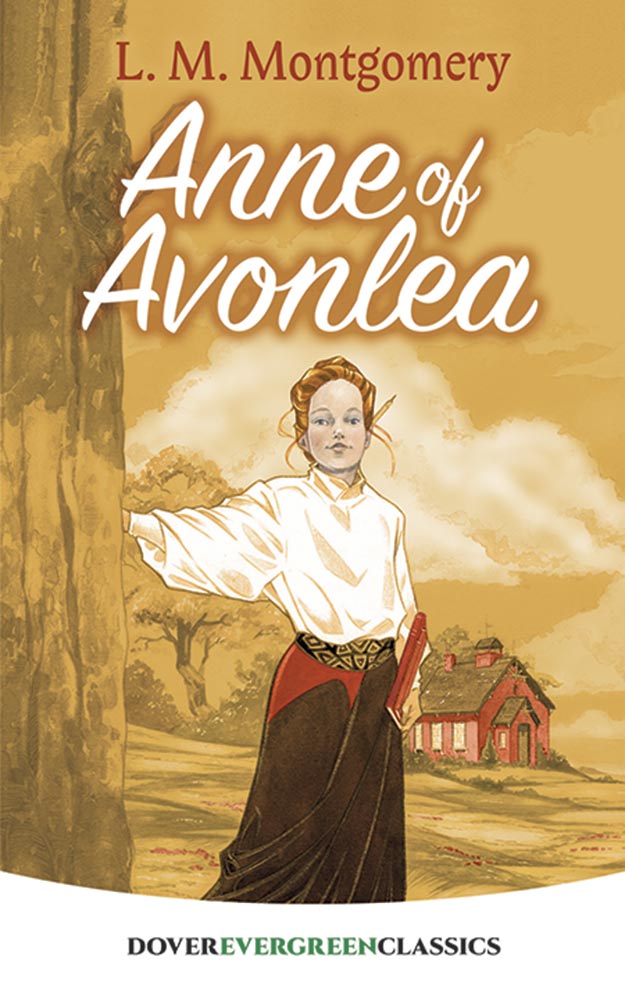
Today's cover comes from Dover Publications in 2002, through their Dover Evergreen Classics line. It's another "Anne standing in front of the schoolhouse" cover, but I've got an odd fondness for this one. Maybe it's the combination of the sepia tones with the red highlights, or the actual spark of personality in her face and pencil behind her ear, but I think it's mostly that she looks like she's dressed for a community theater production of The Pirates of Penzance, which has absolutely no basis in the text but is 100% something Anne would take part in. And it's period appropriate!

Our last couple of installments were pretty light on notes, but we're making up for it with a goodly number this time around:

2:38 - "the world forgetting, by the world forgot." This is another from our old friend Alexander Pope, whom we last saw only three chapters ago. This one is from "Eloisa to Abelard," another of his Latin imitations. This one is not a translation with satire like his "Imitations of Horace," though, but an original poem down in the style of the epistolary poems of Ovid. It retells the well-known medieval story of nun and scholar Héloïse and her tragic affair with her teacher, Peter Abelard. The quote in question come from a portion where Eloisa is talking about how happy vestal virgins must be, having no sins, regrets, or worldly expectations to weigh them down. The passage is also the source of another phrase you may be more familiar with:
How happy is the blameless vestal's lot!The world forgetting, by the world forgot.Eternal sunshine of the spotless mind!
7:13 - "Some are born old maids, some achieve old maidenhood, and some have maidenhood thrust upon them." This is a parody of the well-known Shakespearean quote from Twelfth Night: "Some are born great, some achieve greatness, and some have greatness thrust upon them." It's said by the character Malvolio, pompous steward to the wealthy countess Olivia. He reads it from a letter that he believes to be from her but is actually from several of the secondary characters, who wrote the letter as a prank to make him think Olivia was in love with him. This specific portion is where "Olivia" is assuring him that he need not worry that she so outranks him, and not to be afraid of the greatness that is most definitely now coming his way. In fact, he should start acting like he's already a nobleman and no longer a servant! (Spoilers: it does not go well for Malvolio.)

15:35 - "A Prophet in His Own Country." The title of Chapter 24 is a reference to a Biblical quote that appears in all four Gospels. The wording is different depending on the Gospel and the translation, but he basically says that a prophet may be accepted anywhere other than his own country. No one is going to accept that you're the Son of God (or can accurately predict the weather) when they know your parents, and your siblings, and remember you as a snot-nosed kid, and bought their furniture from you last week.

16:32 - "hymeneal altar." "Hymeneal" is an archaic word that means "having to do with weddings." It comes from the Greek god of weddings, Hymen, and is apparently unrelated to the anatomical word "hymen," despite its socially-constructed associations with "purity" on the wedding night. Seriously, people with hymens are not "sealed for freshness" like vacuum-packed lunchmeat. That's not a real thing.

26:07 - "how potent [the currant wine] was Anne, in her earlier days, had had all too good reason to know." In case you forgot when Anne accidentally got Diana drunk on "raspberry cordial."

28:15 - "Ginger’s gay dead body." I honestly thought this was a typo and supposed to be "gray dead body," because I suppose I had it in my head that Ginger was an African grey parrot. But no, it's like that on Gutenberg as well, so presumably it means that Ginger was a brightly-colored parrot like a macaw, and not that his dead body was especially happy or festive.

30:57 - "there was yet balm in Gilead." Another Biblical reference. The Balm of Gilead was a perfume/resin from a region that is now part of the country of Jordan. It was used medicinally and is mentioned in that context several times in the Bible. Most famously (and pertinently for Davy here) is in Jeremiah 8:22, where the prophet laments the fate of his people:
Is there no balm in Gilead,
Is there no physician there?
Why then is there no recovery
For the health of the daughter of my people?


If you would like to read along, the text can be found at Project Gutenberg. No reading ahead, though!

Tuesday, April 14, 2020

Anne of Avonlea, Chapters Twenty-One and Twenty-Two

In which Anne and Diana accidentally stumble upon an eccentric "old maid" in the woods who, to no one's surprise, turns out to be a kindred spirit, Anne and Marilla discuss said lady while chastising Davy, and the twins' final fate is settled, also to no one's surprise.


Greetings, quarantinos! Today we meet Miss Lavendar Lewis, who was mentioned by Rachel Lynde waaaaaaay back in Chapter One (which I read to you almost, uh, five years ago) when she told Anne about Paul Irving coming to the school, and how his father (now widowed) had been engaged to Miss Lavendar but they split up for reasons unknown. I'm sure none of this will be important at all!

Oh, and I fully realize that I am misspelling "lavender" here, but that's how it's spelled in the book, both for her name and when talking about the actual plant. It's like this in both my paperback and in the Project Gutenberg version, so it doesn't appear to just be an issue with the typesetting of my edition, nor can I find any evidence that this is some sort of "old-fashioned" spelling that Montgomery might have been using, so I guess maybe it's just a mistake that has somehow been carried through for over a century? And no one has wanted to fix it because, like me, they don't want to just change the spelling of a character's name? And they kept the spelling for the plant to, I don't know, make it less obvious? Anyway, I'll spell it correctly if I talk about the plant, but I'll retain the spelling for her name because. . . well, it's her name.

Our cover this time is from an Australian edition from 1955, published by Angus & Robertson (the same folks who did that fourth-wall-breaking cover from the '80s), and I am once again unable to find the artist's name. This one is interesting because it is, I think, the only one I've found that specifically features Paul Irving, despite the rather large part he plays in this particular volume. At least, I assume it's him. I can't think what other young boy might be walking alongside Anne, both carrying school items, while holding a small bouquet and staring up with a dreamy (one might almost say "vacant") expression.) Anyway, it's pretty enough, not wildly inaccurate, and applies to this specific book, so well done!

Just a couple of notes:

19:25 - "horns of elfland." This comes from Alfred, Lord Tennyson, who you may remember from when Anne and her friends reenacted his telling of the story of the Lady of Shalott back in Anne of Green Gables, with hilarious results. This particular one comes from his poem "The Splendor Falls," which describes a sunset he saw over a waterfall in the mountains of Ireland. Go and read it; it's lovely and quite short.

24:51 - "Kerrenhappuch." Keren-happuch was an exceedingly minor character in the Bible. Remember the delightful story of Job? Where Job was a pious and righteous man, and Satan bet God that he was only so righteous because he had a comfy life and enjoyed God's protection, so God let Satan ruin Job's life by killing off his wife and children, financially ruining him, and stealing his health? And Job refused to get angry at God for his misfortunes, just accepting that it was all God's will while despairing that he did not know why? And God rewards his faith by healing him, giving him even more wealth than he had before, a brand-new wife,  and seven new sons and three new daughters who were said to be the most beautiful women in the land? Yeah, Keren-happuch was the youngest of those daughters. Her name means "horn of kohl," so a container of eyeliner, I guess? It's unclear whether Diana was referencing her directly or just picked a weird name that happened to have a Biblical origin, as other people have indeed been called that, and it seems as though it would have been an egregiously old-fashioned name even then.


If you would like to read along, the text can be found at Project Gutenberg. No reading ahead, though!

Tuesday, April 7, 2020

Anne of Avonlea, Chapters Nineteen and Twenty

In which Anne has a very nice day with three boys of varying levels of tediousness, then is surprised with hosting duties while at her least presentable; and in which your narrator is once again unable to restrain himself from complaining about Paul Irving.


Hi-ho, everyone! I hope you're all holding up well, staying home as much as possible and being careful if and when you must leave. Let's escape back into Avonlea for a bit, shall we?

Today's cover comes from the very edition I'm reading from, a Bantam Classics paperback from 1992 with cover art by Ben Stahl. It's a rather lovely painting, though it does fall a bit into that "generic" category I mentioned last time. We've got a pretty well-put-together Anne amidst a bunch of pretty flowers with what I assume is the schoolhouse in the background. Nothing really to tie it to this specific book so much.

Only a couple of mostly-simple notes this time around:

25:38 - "help Mr. Harrison haul dulse." I really expected this to be some sort of grain, but apparently it's a type of red seaweed that's been harvested for food for centuries in Ireland, Iceland, the northeastern US, and the Atlantic coast of Canada (which is, of course, where Prince Edward Island is.) Oh, and fun fact in case you didn't know: seaweed is not a plant, but is actually a type of algae.

35:22 - "forced to content herself with her black lawn." Lawn in this context is a type of plain weave linen, simple and fairly hard-wearing, but not as coarse and cheap as (say) wincey.

37:54 - "feast of reason and flow of soul." Anne here is quoting the great 18th-century English poet Alexander Pope, from his Imitations of Horace. Horace, in turn, was a 1st century CE Roman lyric poet whose works were very popular with Neoclassical writers like Pope. A popular thing for many of these writers to do was to translate classical works like Horaces Satires but update the cultural references, thus satirizing things in the present day in an imitation of the satires of 1800 years prior. Anyway, that's what Pope was doing here, and he used the phrase Anne quoted to describe congenial conversation.


If you would like to read along, the text can be found at Project Gutenberg. No reading ahead, though!

Tuesday, March 24, 2020

Anne of Avonlea, Chapters Seventeen and Eighteen

In which hijinks predictably ensue when Anne tries to host a dinner for a famous author; more ensuing happens when she tries to fix one of the results of said dinner; and in which all it took was a global pandemic to get your narrator to start recording again.


Yes, yes, I know it's been a long, LONG time since my last recording, and even long since I started this book (coming up on five years!), but right now I feel we could all use a little something to keep ourselves occupied, and that's as good an excuse as any.

Anyway, cover! We've got this 1997 edition published by Penguin Classics. This is a nice one because it's one of the very few that depicts an actual scene from the novel, instead of some generic, baffling, or vaguely terrifying picture of a girl who could conceivably be Anne (or not). This artist (whose name was not listed in the copyright info inside the book, boo, credit your artists) clearly read the book, or was at least given very clear instruction from someone who did.

And now, your notes!

4:22 - "antimacassars." I could swear I'd covered this one at some point already, but search is coming up empty. Anyway, the cloths (often lacy, frilly, and/or embroidered) which are draped over the headrests and sometimes arms of chairs? Those are antimacassars. Macassar hair oil (so called because its ingredients were supposedly purchased at the port city of Makassar in the Dutch East Indies, now Indonesia) was extremely popular among Western Europeans throughout pretty much the entire 19th century, but it had a tendency to transfer to and stain fabric, so antimacassars were put on chairs to prevent that from happening. You still see them on chairs that get high usage, like on buses, trains, and planes.

4:46 - "a great blue bowlful of snowballs." This most likely refers to Hydrangea aborescens, alternatively known as the smooth hydrangea, wild hydrangea, sevenbark, or snowball bush.

4:55 - "Every shelf of the what-not. . ." You know those spindly little freestanding shelves? They're like end tables, but with multiple levels, and each shelf is maybe six inches across, and it's only really good for holding knick-knacky little crap? That's a what-not.

6:26 - "bread sauce." Maybe this is a common thing in some areas and I just haven't heard about it, but in case you're in the same boat: this is basically what you would think, a type of milk-based sauce/gravy that is thickened with bread crumbs, typically served with fowl.

8:42 - "her namesake in the Bluebeard story peered from the tower casement." This is, obviously, a reference to the story of Bluebeard, in which a young wife disobeys her new husband's orders not to look in a specific locked room, even though he gives her a key, and finds the remains of all his previous wives. In the Charles Perrault version of the story, the unnamed bride sends her sister, Anne, up to the top of the tower to keep a lookout for their brothers coming to save her.

9:22 - "twenty dollars." I can't find US-Canada exchange rates past 1913, but it seems to have held roughly steady at 1-1 for pretty much that whole time, so I'll go ahead and say that it was probably equal to about 20 US dollars at the time. Using various inflation calculators for roughly the time the story takes place (1880s?) and the time it was written (early 1900s), it looks like that's somewhere between $500 and $600 today, and the $25 that Anne eventually shells out for it is more like $700, which, WOW, sounds about right for rich old Aunt Josephine, but sounds a bit much for Anne to have been able to actually cover, so maybe my calculations are off somehow.

23:04 - "over the mountains of the moon / down the valley of the shadow." These lines come from the 1849 poem "Eldorado," by Edgar Allan Poe. It's about a knight looking for and failing to find the famous city of gold. It was one of Poe's last poems before he died, and written at least in part about the 1849 gold rush. And, if I am interpreting these specific lines right, Anne is basically telling young Davy that "sleep" is in the land of the dead. Dark.

26:36 - "jumping on the spare room bed. . . I must refer them to Anne's earlier history." This of course refers to the events of Chapter 19 of Anne of Green Gables, where Anne and Diana accidentally jump on old Miss Barry, thinking the bed she was in was empty.

36:12 - "Do send it to the Canadian Woman." This sounds like a magazine or periodical of some sort, but I can't find any that were ever called that, so perhaps it's made up?

38:25 - "cowcumbers." This is a very old name for cucumbers, apparently considered hopelessly old-fashioned even back in the 1830s. Its use here -- and the scare quotes around it when it's repeated in the narration -- is presumably to mark Miss Copp as a particularly rustic and uneducated person (as does her saying that "I didn't know men were so skurse."

And that's it! I'll see you next time, hopefully in increments of days rather than years.


If you would like to read along, the text can be found at Project Gutenberg. No reading ahead, though!

Tuesday, January 17, 2017

Anne of Avonlea, Chapters Fifteen and Sixteen

In which summer vacation begins with a joyous trip to the graveyard, a question of theological geography is cleared up, and Anne prepares for a visit from a literary luminary; and in which our narrator asks if anything interesting happened while he was gone.


Hey, remember me? Been a long time! Almost exactly a year to be specific, after which an escape back to Avonlea — which, apropos of nothing, is in Canada — is sounding really good.

First up, our cover this time around comes from a 1987 edition published by the Australian firm of Angus and Robertson, where they published the whole series with covers that included something breaking out of the frame for some reason. I'd like to think that this symbolized Anne's out-of-the-box thinking or something, but they probably did this with lots of other books as well. And frankly, I don't know if I really feel comfortable with a post-modern, fourth-wall-breaking Anne.

Now for notes!

8:35 - "How fair the realm / Imagination opens to the view." All right, I am totally drawing a blank on where this quotation comes from. All the sources I can find list Ms. Montgomery as its author, though it's clearly formatted as a quotation in the text. Moreover, Montgomery has quoted this more than once: in a 1903 diary entry (six year before Anne of Avonlea was published and in a 1927 letter, for instance, each time clearly delineated with quotation marks. Looking for only part of the phrase (in case she's paraphrasing) gets the same results. Anyone else have any ideas?

8:55 - "east o' the sun, west o' the moon." Oh good, this one's easy. This is from a Norwegian folk tale of the same name, where the title refers to the impossible-to-find location of the troll castle the heroine's husband was spirited away to. Also her husband was a bear. I think I may actually read this as our next Short Story Interlude, if only to tell you the personal connection I have with it and explain one of my more esoteric tags.

11:31 - "Not failure but low aim is crime." Helpfully, Mrs. Allan partly sources this one herself, attributing it to "Lowell." This turns out to be the American Romantic poet James Russell Lowell (1819-1891), from his poem "For an Autograph." The whole line reads
Greatly begin! though thou have time
But for a line, be that sublime,—
Not failure, but low aim, is crime.
Which, FINE, I've already started recording again, sheesh. Quit bugging me, Lowell.

25:50 - "In the elder days of art / Builders wrought with greatest care / Each minute and unseen part / For the gods see everywhere" Ah, again helpfully sourced in the text! This is from "The Builders," by Henry Wadsworth Longfellow in his 1850 collection The Seaside and the Fireside (the "Fireside" portion, in case you're curious). Longfellow, incidentally, was part of the group of 19-century New England poets called the Fireside Poets, which also included James Russell Lowell. Montgomery had certain preferences.

Oh, and you may have noticed that I've switched over to hosting my books on SoundCloud! This means you can more easily stream them to your phone through their handy app, where they're already helpfully parceled out into their own playlists. You can find all of my stuff here, where you can also favorite, make comments, subscribe, etc. At some point I'll go back and update all the old posts with the new embedded player.


If you would like to read along, the text can be found at Project Gutenberg. No reading ahead, though!

Wednesday, January 13, 2016

Anne of Avonlea, Chapter Fourteen

In which the twins will be staying with Anne and Marilla for a little longer, to no one's surprise, a theological discussion is had, and a potential disaster for the Improvement Society is averted by political corruption; and in which the narrator just sort of gives up on keeping all the very minor characters' voices straight.


Welcome back! I hope everyone had a good holiday season. We're diving back into Avonlea with the drama of aesthetically displeasing advertisements. No notes this time around, so we'll just have this installment's cover, from Aladdin Classics in 2005:


This has what appears to be an actual vintage photograph, which works fine as it's at least roughly the right time period and age to be Anne. I am curious, though, as to what exactly is going on with her left hand there. Is it just me, or is that handbag rather blatantly photoshopped in? Why is her hand in such an awkward position? Is that photoshopped too? Why would they do either of those things? Why is the bag flying up like that? Is she supposed to have just moved her forearm up very quickly for some reason that the rest of her body is unaware of? Is it just about to whap her in the face? I DON'T UNDERSTAND WHAT'S HAPPENING.


If you would like to read along, the text can be found at Project Gutenberg. No reading ahead, though!

Monday, December 7, 2015

Anne of Avonlea, Chapters Twelve and Thirteen

In which Anne has a very cranky day and finds her personal educational philosophy slipping, but then celebrates a pseudo-birthday by exploring the countryside and learning a terribly tragic story; and in which our narrator wonders whatever happened to Anne's toothache, because she should really get that checked out, seriously now.


Today's cover is from a 1995 Norstedts printing of the Swedish edition of Vår vän Anne. I like that this one shows Anne with (presumably) Davy and Dora, who I have never seen featured anywhere. Heck, they're hardly ever even mentioned when talking about these books, so it's rather nice to see them on a cover. In Sweden, anyway. I also appreciate that Davy looks like he's trying to claw his way out of those fancy clothes that are strangling him.

Unnecessarily complex notes to follow!


10:56 - "by what somebody has called 'a Herculaneum effort.'" Herculaneum was an ancient Roman city that was, like the more famous Pompeii, buried by the eruption of Mount Vesuvius in 79 CE. It was wealthier than Pompeii, and actually better preserved, containing organic remains like wood, food, beds, and even skeletons. The destruction of Pompeii, though, was famously witnessed and described by Pliny the Younger, so it's distinctly the better-known.

Of course, that doesn't have much to do with this quote, which is a malaprop for the idiom "a Herculean effort." I'm not sure who the "somebody" is that Montgomery is attributing this phrase to, though. My best guess comes from an 1894 travelogue called Our Journey Around the World, by Rev. Francis Clark and Harriet Clark, where the narrator says "with a Herculaneum effort, as Mrs. Partington would have said..." Mrs. Partington turns out to be a character created by American humorist B. P. Shillaber in the 1850s who is described as an American Mrs. Malaprop (who, in turn, was from the play The Rivals by Richard Brinsley Sheridan and who, of course, gave her name to the practice of humorously replacing one word for another, similar-sounding one). The texts the Mrs. Partington are from, though, don't appear to be readily available online, at least not in searchable form, and what I can find does not appear to use particular term. I found other people in the 1800s making this same malaprop, though, so maybe it was just a semi-common joke with no specific source.

12:58 - "plum puffs won't minister to a mind diseased" Ah, okay, this one's easy. Anne here is adapting a quote from Act V, Scene III of Shakespeare's Macbeth:
MACBETH: How does your patient, doctor?

DOCTOR: Not so sick, my lord,
As she is troubled with thick-coming fancies
That keep her from rest.

MACBETH: Cure her of that!
Canst thou not minister to a mind diseased,
Pluck from the memory a rooted sorrow,
Raze out the written troubles of the brain,
And with some sweet oblivious antidote
Cleanse the stuffed bosom of that perilous stuff
Which weighs upon her heart.

DOCTOR: Therein the patient
Must minister to himself.
One should note that by quoting this, Anne is casting herself in the part of Lady Macbeth, guilt-ridden over the murder of King Duncan.

13:37 - "Every morn is a fresh beginning / Every morn is the world made new." Anne here is caroling the start of the poem "New Every Morning," from the 1889 book A Few More Verses by Susan Coolidge (1835-1905, real name Sarah Chauncey Woolsey, and also author of, of course, Verses). As far as I know, it was never set to music. If it ever was, it most certainly was not whatever travesty I saddled it with.

17:45 - "harrowing." A harrow is an agricultural tool made up of many spikes, discs, or tines which are dragged across plowed soil to smooth it out and break up large clump of dirt, giving it a finer and more finished appearance  that is also better for seeding. This is also where the word "harrowing" comes from, as in "a harrowing experience." Because, well, imagine being dragged through this sucker.

18:17 - "Begone, dull care!" This comes from an old English folk song that dates back to at least the 1600s, and possibly earlier.

19:14 - "It would be too hot to hold some folks." ...yeah, no, I still have no idea what Jane is so "sagely quoting" here, if indeed anything.
 
20:21 - "elephant's ears." I'm not sure which of the various related plants referred to as "elephant ears" they are referring to, but as far as I can tell none of them would be described as "graceful" or "feathery," or appropriate for "picking a big bunch," as they're primarily known for their very large, leathery, heart-shaped leaves rather than their flowers.


If you would like to read along, the text can be found at Project Gutenberg. No reading ahead, though!

Wednesday, December 2, 2015

Anne of Avonlea, Chapters Ten and Eleven

In which Davy makes a good deal of trouble due to not being brought up right, and Anne writes a letter to someone we don't care about relating numerous funny, strange, or creative things her students have said; and in which our narrator is pretty sure that if Anne were around today she'd totally have her own Tumblr.


Today's cover is from Sterling Publishing in 2008 and makes the unusual choice of showing Anne as a teacher, with her class. I hadn't really realized it before, but it really is a bit odd that so few covers seem to depict her in this way, considering how a big part of this book relates to her teaching and relationships with her students. Here's a fun game: try and figure out which of these students are the saintly Paul Irving, the terrible Anthony Pye, the put-upon St. Clair Donnel, the clumsy Barbara Shaw, and the coquettish Prillie Rogerson! And wonder if the illustrator actually tried to represent the specific children or not! (I really have no idea if they did or did not.)

Notes:

12:59 - "asseverated." Man, the Pyes animadvert, Davy asseverates... Ms. Montgomery, I love you and I love your work, but you need to put down your thesaurus for a while. You can just say that Davy declared, or asserted, or stated earnestly or something.

21:00 - "Thomas à Becket." AKA St. Thomas of Canterbury, Thomas Becket was the Archbishop of Canterbury during the reign of King Henry II in the twelfth century. Though the two had started out as friends, after his election to the archbishopship (... is that a word? That doesn't look right.) Becket had a bit of a change of heart and came into conflict with the king regarding the relative rights of the crown and the church. It got so bad between them that in 1170 Henry said... something. It's uncertain what, exactly, though tradition states it was "Who will rid me of this troublesome priest?" Whatever it was, it was interpreted (rightly or wrongly) by four of his knights as an order. They found Becket in Canterbury and demanded he come and account for himself. He refused, went in to say vespers, and they killed him. The Catholic and Anglican churches both venerate him as a martyr and a saint.

You might notice something missing from the above account, though: the "à." It's not actually part of his name, and no one's entirely sure why people sometime in the 1600s or so started putting it in there. Some say it was in imitation of Thomas à Kempis for some unknown reason. It doesn't even make sense in Becket's name, because it means "of" or "from" (so Kempis's name actually means "Thomas from Kempen," where Kempen was his hometown.) But Becket wasn't from anywhere named "Becket." One of those weird linguistic mysteries how it really got and stayed there for so long.

21:05 - "William Tyndale wrote the New Testament." Tyndale was a 16th-century English scholar, best known for his translation of the Bible into English at a time when unauthorized English Bibles were against the laws of both the Church of England and England itself. His was also the first English Bible to work directly from Greek and Hebrew texts (rather than working from later translations into Latin), and the first to be printed on the printing press. He later went on to vocally disapprove of King Henry VIII's divorces. For these varied crimes, he was eventually convicted of heresy and burned at the stake. Well, strangled to death while tied to the stake, and then burned.

21:09 - "Claude White says a 'glacier' is a man who puts in window frames!" Claude White is of course looking for the word "glazier."

22:32 - "carded rolls." Carding is a process of basically turning a raw, fibrous material like cotton or wool into a useful form by untangling the fibers, laying them out parallel to each other, and locking them together in a sort of web, using a sort of brush/comb called a card. This creates a sort of mat that can be pulled up off the card in rolls that can then be used to spin out yarn.


If you would like to read along, the text can be found at Project Gutenberg. No reading ahead, though!

Monday, November 30, 2015

Anne of Avonlea, Chapters Eight and Nine

In which, as explained handily by the chapter title, Marilla Adopts Twins and hi-jinks ensue when one turns out to be the anti-Paul Irving, followed by the completion of the A.V.I.S.'s first project which is ruined by those damn dirty Pyes.


Hey, it's Lucy Maud Montgomery's 141st birthday today! As is their wont, Google honored her with three Doodles depicting scenes from Anne of Green Gables. My favorite is of course the one where Anne eats her infamous liniment cake, but they're all delightful. Be sure to check out the early sketches at the bottom, including a couple of her (and Gilbert!) in school.

Today's cover comes from the 2009 Puffin Classics relaunch and wow, does it kind of irrationally freak me out. I mean, is it just me or does it look like it was done in Microsoft Paint? It looks like I wasn't the only one not fond of it, because it seems like this (and the matching covers for the rest of the series) was pretty speedily replaced and is now rather hard to find.

Notes!

2:25 - "dashboard." Okay, okay, obviously y'all know the word "dashboard" already, but it's possible you're wondering why it's being used in the context of a horse-drawn buggy. See, this is one of those words that has continued on long after its literal meaning has ceased to be relevant, sort of like how we still use an icon of a floppy disk to mean "save." When horses move quickly on dirt or gravel paths, their hooves would throw — or dash — muck up at the driver and passengers behind them in the cart or carriage or whatever. Thus, a board was placed at the front of the carriage to protect the riders.

Buggy (PSF)
A horse-drawn buggy, with a dashboard sticking up between the horse and the passengers.

By Pearson Scott Foresman [Public domain], via Wikimedia Commons

When motorcars first came about, they were mostly made by the same people who made horse-drawn carriages and were pretty much just built with the same plans, only with an engine added.

Sears Model L
Sears Model L motor buggy

By Unknown - advertisement (Gleanings in Bee Culture) [Public domain], via Wikimedia Commons

Once it became standard to have the engine in the front, it was only natural that the dashboard remain to separate it from the passengers, as it once did the horses.

1909 Ford Model T T1 Town Car (12703369904)
1909 Ford Model T T1 Town Car

By Sicnag [CC BY 2.0], via Wikimedia Commons

People already knew "the barrier right in front of you when you're driving" as "the dashboard," so the name stuck around. It eventually became a handy and natural place to set things and locate controls and gauges and such, so that today "dashboard" is practically synonymous with "instrument panel," leading to things like the Mac Dashboard. Pretty far from horses kicking dirt into your face!

8:23 - "a 'prunes and prisms' mouth." This is a reference to the lesser-known Charles Dickens novel Little Dorrit (1857), where Mrs. General (a governess in all but name, hired to train the young heroines to become proper young ladies) teaches her charges to say this phrase to form their mouths into an attractive shape:
'Papa is a preferable mode of address,' observed Mrs General. 'Father is rather vulgar, my dear. The word Papa, besides, gives a pretty form to the lips. Papa, potatoes, poultry, prunes, and prism are all very good words for the lips: especially prunes and prism. You will find it serviceable, in the formation of a demeanour, if you sometimes say to yourself in company—on entering a room, for instance—Papa, potatoes, poultry, prunes and prism, prunes and prism.'
 It thus became a byword for a prim and affected form of speaking.

14:13 - "coin-spot rug." Also known as a penny rug, these were made from small circular pieces of fabric, cut from scraps left over from clothing and such using coins as templates, sewn together to make a rug, mat, or decorative thingy.

26:42 - "animadverted." Well, this is a word I've never come across before! "Animadvert" just means to comment upon in a critical or unfavorable way.


If you would like to read along, the text can be found at Project Gutenberg. No reading ahead, though!

Monday, November 23, 2015

Anne of Avonlea, Chapters Six and Seven

In which Anne and Diana try to bilk the hard-working citizens of Avonlea out of their money with mixed success and Marilla is duped into spending her golden years taking care of young children; and in which the narrator lets slip an Opinion about a character we've only barely met.


Today's cover is from a Grosset and Dunlap edition from 1936, and is a great example of how the fashions of the time were often taken more into consideration than anything actually in the book. I mean, you can't even try to pretend that look anything like 1880s style, or even the styles of 1909, when the book was written. And I suppose you could generously consider her hair to be auburn there, which is at least sort of close to red, but really. You can at least get that right. As it is, this looks a lot more like a Nancy Drew cover than Anne Shirley. Though, come to think of it, Nancy was also published by Grosset and Dunlap in the 1930s. It's quite possible it's the same cover artist, or at least a house style the artists were supposed to conform to.


1:38 - "All Sorts and Conditions of Men... and Women." The title of Chapter 5 is a reference to a line from The Book of Common Prayer, which (for those of us not in the Anglican Church) was a book that laid out prayers and services for specific occasions, like morning prayers, evening prayers, funerals, baptisms, etc. This line is from, appropriately enough, the "Prayer for All Sorts and Conditions of Men," which basically is a sort of all-purpose prayer for any in need of help.

2:47 - "Bliss is it on such a day to be alive." Anne of course properly attributes the source of her altered quotation to William Wordsworth. The poem specifically is the succinctly titled "The French Revolution as It Appeared to Enthusiasts at Its Commencement," and the actual line is "Bliss was it in that dawn to be alive, / But to be young was very heaven!" Man, the French Revolution sounds amazing! Really though, I'll stick with the scent of fir.

8:22 - The "vale of tears" that Eliza insists on seeing the world as is an old Christian phrase referring to the idea that the physical world is just a place full of sorrow and sadness that we leave behind when we go to heaven.

25:04 - "a fighting animal." This was a surprisingly tricky one to find out. The most famous quote defining man as a fighting animal is from George Santayana, where he says "Man is a fighting animal, his thoughts are his banners, and it is a failure of nerve in him if they are only thoughts." However, he said this in his book Dialogues in Limbo which was published in 1925, well after Anne of Avonlea. Most other references, like Gilbert here, leave the source as "someone." Eventually though, through an 1880 quoting from "I believe the late Lord Palmerston." Henry John Temple, 3rd Viscount Palmerston, was Prime Minister of the UK under Queen Victoria from 1855-1858 and from 1859 until his death in 1865. The quote is from a January 8, 1862 letter to Richard Cobden, a politician whose anti-war views often put him at odds with Palmerston. The full quote reads:
It would be very delightful if your Utopia could be realized, and if the nations of the earth would think of nothing but peace and commerce, and would give up quarrelling [sic] and fighting altogether. But unfortunately man is a fighting and quarrelling animal; and that this is human nature is proved by the fact that republics, where the masses govern, are far more quarrelsome, and more addicted to fighting, than monarchies, which are governed by comparatively few persons. [Emphasis added]
Ah, that explains it! No one ever really makes reference to the "and quarreling" bit, just the fighting. It would take Gilbert's point a little less dramatic if he said he wanted to quarrel with disease and pain and ignorance.


If you would like to read along, the text can be found at Project Gutenberg. No reading ahead, though!

Saturday, November 21, 2015

Anne of Avonlea, Chapters Three to Five

In which Anne confesses her bovine misdeed to Mr. Harrison and the two become friends, there is some disagreement about methods of classroom discipline, and Anne has a most tiring first day of school; and in which the narrator tries to remember what he recorded nearly two months ago, itself after a two-month break.


Hey, remember Avonlea? We're going to pick up right where we left off, of course, with Anne trepidatiously heading over to Mr. Harrison's house to confess about accidentally selling his Jersey cow.

Here's this installment's cover, a lovely paper-cut design by Simon and Schuster as part of their Aladdin Classics series. I like how this incorporates various aspects of the book: the parrot Ginger, Anne's Jersey cow, the Avonlea Village Improvement Society. It sets it apart from the vast stretches of "Anne standing in a field" covers, which... okay, we'll be seeing several of them I'm sure, because the pickings are a little slimmer for this than for Green Gables. Simon and Schuster have done similar covers for a few other Anne novels, too!

A few short notes:

 8:31 - "as good a jorum of tea as you ever drank." A jorum is a large bowl or, more likely in this case, jug that is used to serve beverages; usually punch, but sometimes tea. It's sometimes also used to refer to the contents of such a vessel, often implying a great deal of such contents.

23:17 - "shining morning faces." This is a reference to the famous "Seven Ages of Man" speech (aka, "All the world's a stage...") from Act II, Scene VII of Shakespeare's As You Like It:
All the world's a stage,
And all the men and women merely players:
They have their exits and their entrances;
And one man in his time plays many parts,
His acts being seven ages. At first the infant,
Mewling and puking in the nurse's arms.
And then the whining school-boy, with his satchel
And shining morning face, creeping like snail
Unwillingly to school.
Out of context, one might interpret "shining" to mean something like "beaming" or "eager" — which is definitely how Montgomery means it here — but nestled between "whining" and "creeping like a snail unwillingly to school," one wonders if maybe Shakespeare meant that their faces are shining with tears instead. I mean, read the rest of the speech. It's... not exactly optimistic.

28:57 - "slate bottle." This was actually a rather difficult one to find! Eliminating things like this and this still mostly brought up references to ink bottles, which doesn't make sense in this context as it clearly says that the bottle held water, and you wouldn't use ink on a slate anyway. The only (well, first, because then I stopped looking as I'd already gone pretty deep) explicit reference I found is in this 1889-1926 history of Eastling Primary School in Kent County, England, where a former student recalls "how happy she was when she... was given her own slate, her own water bottle with a hole in the cork, and a rag to clean her slate." I mean, you could probably have figured out that it was basically a very low-tech water spritzer for cleaning slates from the context and a basic knowledge of how slates work, but it's nice to have confirmation.


If you would like to read along, the text can be found at Project Gutenberg. No reading ahead, though!

Tuesday, July 28, 2015

Anne of Avonlea, Chapters One and Two

In which we catch up with our red-headed heroine, learn of her plans to improve society, meet her new cranky neighbor, and watch her get into trouble over a cow; and in which the narrator has to remind himself which of these voices were done in the first book, and for those that were, what they sounded like.


All right, despite six Beatrix Potter stories in a row I've still got to shake off some of the doldrums that, to be honest, Frankenstein rather left me in. I need someone happy. I need someone bright, and joyous, and who celebrates life. I need... Anne Shirley. Come to think of it, Anne Shirley practically is the anti-Victor Frankenstein. You just know that every single bad thing that happened in Frankenstein would've been averted if Anne had been there to take responsibility and show the creature some kindness on a boat ride upon the Lake of Shining Waters.

What, these are the things I think about.

ANYWAY, we are indeed going to head back with the second Anne book, Anne of Avonlea, published in 1909. It seems that Ms. Montgomery's publisher's were so impressed with her that they asked for a sequel to Anne of Green Gables (1908) as soon as she signed the contract for it, and they actually had to delay Avonlea's publishing because Green Gables was still selling so well!

Unfortunately, it looks like there weren't any illustrations in the first edition of this, and none in the public domain that I can find, so as with the first book I'll fill in with various editions' covers. We'll start with the cover of that first edition, done in a similar style to the original. Like the cover of Green Gables, the illustration on this one is by George Gibbs. Unlike Green Gables, George Gibbs was properly credited on the title page for both this illustration and the frontispiece, seen below.

Some short notes:

8:38 - The disagreeable Mr. Harrison doesn't want to contribute to the reverend's salary before hearing him sermonize because he doesn't want to buy "a pig in a poke." First, a "poke" is an archaic word for a bag. It goes back to the same root word as "pocket," which, with the -ette diminutive suffix, meant "little bag. Anyway, back in medieval times, pigs were relatively scarce but dogs and cats were pretty common. So, con men would sometimes tie, say, a cat up in a bag and sell it to someone claiming that it's nice fresh pig. The savvy customer would know enough to check before buying by opening it up and letting the cat out of the bag and yes, this is probably where that phrase came from as well. Basically, it all boils down to "Buyer beware."

17:26 - Mrs. Lynde references an — in her eyes, at least — unsavory man who is often "in consumption." And... really? Have we not had to define "consumption" yet? Huh. Well, "consumption" referred to a disease that wasted the body away, usually specifically tuberculosis.

18:38 - Mrs. Lynde says such things, especially about "Yankees" with "a decided can-any-good-thing-come-out-of-Nazareth air." This is a reference to the Bible passage John 1:46, where Philip tells his friend Nathanael "Hey, wanna meet this cool guy, Jesus of Nazareth? He's totally the Messiah!" (I'm paraphrasing.) Nathanael responds with the quoted bit, letting us know that at the time Nazareth was not a very highly-looked upon place. It also tosses a little bit of irony into Mrs. Lynde's attitude (as if there wasn't enough already), because of course according to the Bible and thus probably according to Mrs. Lynde a very good thing did, in fact, come out of Nazareth.


If you would like to read along, the text can be found at Project Gutenberg. No reading ahead, though!

Monday, October 28, 2013

Anne of Green Gables, Chapters Thirty-Seven and Thirty-Eight

In which there is sadness, new plans, reconciliations, and the bend in the road.


Our final installment of Anne of Green Gables brings with it our final original illustration, as well:

25:26 - "'Come, I'm going to walk home with you.'"

Obviously destined to be together.

Anyways, Ms. Montgomery inserts a couple of other quotes. She makes reference to "loss in all familiar things," a reference to the poem "Snow-Bound: A Winter Idyl" by John Greenleaf Whittier, a long poem in which a family is trapped in the homestead for three days during a snowstorm, and pass the time by sharing stories. The quote comes, unsurprisingly, from a section about mourning a lost loved one.

The "Josiah Allen's wife" Anne refers to is Marietta Holley, a satirist from the last 1800s who appears to be largely forgotten today. The term "mejum" appears to come from Holley's novel called — oh dear — Sarah Among the Colored Folks. It seems to mean "medium," in context meaning "moderate" or "reasonable."

When the narration refers to Avonlea as "a haunt of ancient peace," it's quoting Tennyson again, this time his poem "The Palace of Art," supposedly referring to Gunby Hall, a country house in England allegedly haunted by the spirit of a former servant who was murdered sometime in the early 1700s by the hall's lord as he was running away with the lord's daughter (or maybe wife.) Nice and peaceful!

Finally, Anne's last line is from "Pippa Passes," a drama by Robert Browning. The whole quote goes:
"The year’s at the spring,
And day’s at the morn;
Morning’s at seven;
The hill-side’s dew-pearled;
The lark’s on the wing;
The snail’s on the thorn;
God’s in His heaven—
All’s right with the world!"
Which of course brings us to the end of the book. Thanks so much for listening.

(And like you didn't get at least a little choked up too. Shut up.)


If you would like to read along, the text can be found at Project Gutenberg. No reading ahead, though!