
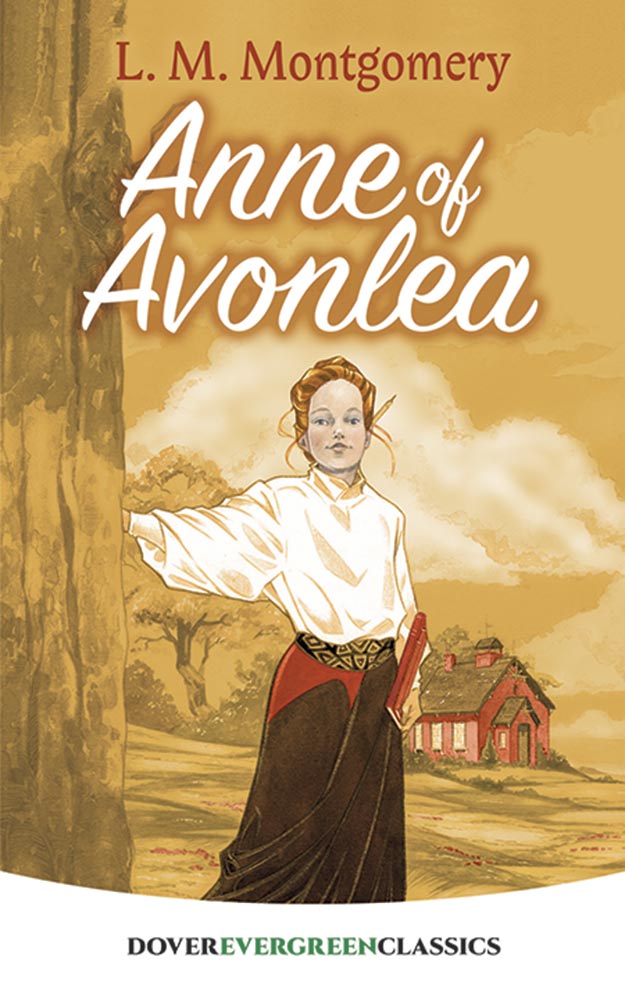
 Today's cover comes from Dover Publications in 2002, through their Dover Evergreen Classics line. It's another "Anne standing in front of the schoolhouse" cover, but I've got an odd fondness for this one. Maybe it's the combination of the sepia tones with the red highlights, or the actual spark of personality in her face and pencil behind her ear, but I think it's mostly that she looks like she's dressed for a community theater production of The Pirates of Penzance, which has absolutely no basis in the text but is 100% something Anne would take part in. And it's period appropriate!
Our last couple of installments were pretty light on notes, but we're making up for it with a goodly number this time around:
2:38 - "the world forgetting, by the world forgot." This is another from our old friend Alexander Pope, whom we last saw only three chapters ago. This one is from "Eloisa to Abelard," another of his Latin imitations. This one is not a translation with satire like his "Imitations of Horace," though, but an original poem down in the style of the epistolary poems of Ovid. It retells the well-known medieval story of nun and scholar Héloïse and her tragic affair with her teacher, Peter Abelard. The quote in question come from a portion where Eloisa is talking about how happy vestal virgins must be, having no sins, regrets, or worldly expectations to weigh them down. The passage is also the source of another phrase you may be more familiar with:
How happy is the blameless vestal's lot!The world forgetting, by the world forgot.Eternal sunshine of the spotless mind!7:13 - "Some are born old maids, some achieve old maidenhood, and some have maidenhood thrust upon them." This is a parody of the well-known Shakespearean quote from Twelfth Night: "Some are born great, some achieve greatness, and some have greatness thrust upon them." It's said by the character Malvolio, pompous steward to the wealthy countess Olivia. He reads it from a letter that he believes to be from her but is actually from several of the secondary characters, who wrote the letter as a prank to make him think Olivia was in love with him. This specific portion is where "Olivia" is assuring him that he need not worry that she so outranks him, and not to be afraid of the greatness that is most definitely now coming his way. In fact, he should start acting like he's already a nobleman and no longer a servant! (Spoilers: it does not go well for Malvolio.)
15:35 - "A Prophet in His Own Country." The title of Chapter 24 is a reference to a Biblical quote that appears in all four Gospels. The wording is different depending on the Gospel and the translation, but he basically says that a prophet may be accepted anywhere other than his own country. No one is going to accept that you're the Son of God (or can accurately predict the weather) when they know your parents, and your siblings, and remember you as a snot-nosed kid, and bought their furniture from you last week.
16:32 - "hymeneal altar." "Hymeneal" is an archaic word that means "having to do with weddings." It comes from the Greek god of weddings, Hymen, and is apparently unrelated to the anatomical word "hymen," despite its socially-constructed associations with "purity" on the wedding night. Seriously, people with hymens are not "sealed for freshness" like vacuum-packed lunchmeat. That's not a real thing.
26:07 - "how potent [the currant wine] was Anne, in her earlier days, had had all too good reason to know." In case you forgot when Anne accidentally got Diana drunk on "raspberry cordial."
28:15 - "Ginger’s gay dead body." I honestly thought this was a typo and supposed to be "gray dead body," because I suppose I had it in my head that Ginger was an African grey parrot. But no, it's like that on Gutenberg as well, so presumably it means that Ginger was a brightly-colored parrot like a macaw, and not that his dead body was especially happy or festive.
30:57 - "there was yet balm in Gilead." Another Biblical reference. The Balm of Gilead was a perfume/resin from a region that is now part of the country of Jordan. It was used medicinally and is mentioned in that context several times in the Bible. Most famously (and pertinently for Davy here) is in Jeremiah 8:22, where the prophet laments the fate of his people:
Is there no balm in Gilead,
Is there no physician there?
Why then is there no recovery
For the health of the daughter of my people?
If you would like to read along, the text can be found at Project Gutenberg. No reading ahead, though!
